An incident ticket can look complete until the answer has to travel back into the system that owns the work. The model may return a sound analysis, yet the workflow can still fail if a circuit ID reconnects incorrectly, a protected reference remains unresolved, or the result lands in the wrong record.
That is why a deterministic Reconstruction test must cover the entire return path. It should prove that valid context-preserving substitutes resolve to the correct authorized values, invalid references remain explicit, and the reconstructed output reaches the intended system without moving originals or the protected mapping outside the customer-controlled environment.
That requires more than a successful demo. The test needs a known source record, an approved model path, negative cases, a real downstream destination, and evidence from the full return path. Teams that need to evaluate the entire architecture can start with the context-preserving data layer evaluation checklist. This article focuses on the narrower decision: whether the Reconstruction stage is ready for one production workflow.
Key takeaways
- Deterministic Reconstruction describes scope-bound mapping resolution, not deterministic model behavior.
- Test the downstream write, not only the text returned by the model or Reconstruction component.
- Run negative cases for unknown, altered, expired, unauthorized, and out-of-scope substitutes.
- Retain enough evidence to reproduce the decision without copying original values into unnecessary logs.
Why does a successful model response still need a return-path test?
A successful model response proves that the approved model completed its task on the protected working version. It does not prove that the result can be reconnected to authorized operational values, delivered to the correct system, or handled predictably when a reference is missing or malformed.
Consider an incident-analysis workflow. The original record contains a circuit ID, a topology node, and an incident number. A context-preserving data layer creates a protected working version that keeps those relationships usable for the model. The model returns a technically sound root-cause analysis, but its response still contains protected substitutes.
The workflow is not complete until Reconstruction reconnects the permitted values and the originating ticketing system receives the approved result. A test that stops at the model response misses the point where original values re-enter the workflow. A test that stops at the Reconstruction API misses the final write, including any formatting, authorization, or retry behavior introduced downstream.
The acceptance boundary therefore runs from the source record to the stored result. It includes the original input, protected working version, model request and response, protected mapping decision, reconstructed output, and actual downstream write. OWASP’s LLM02:2025 guidance treats sensitive information disclosure as an application-context and output risk, which supports reviewing the surrounding workflow rather than inspecting only the prompt.
For the broader mechanics and integration patterns, read how AI output reconstruction works. The goal here is to turn those mechanics into observable pass and fail conditions.
What are the limits of deterministic Reconstruction?
A deterministic Reconstruction test can prove one bounded property: within the applicable mapping scope, a valid context-preserving substitute resolves to its mapped value consistently. The term describes the mapping operation, not the behavior of the language model or the correctness of the complete workflow.
If a protected record uses one substitute for the same circuit across an alert, topology reference, and ticket history, valid occurrences should reconnect to the same authorized circuit ID. That exact relationship is testable. The team can compare the known mapping decision with the reconstructed result and confirm whether every permitted occurrence resolved as expected.
Deterministic Reconstruction does not mean:
- the model will generate the same response on every run;
- detection will find every sensitive value;
- the model will preserve every substitute exactly;
- every caller may reconnect every value;
- an unknown reference has a valid mapping;
- the downstream system will store the result correctly.
These are separate conditions with separate owners. Model settings, prompts, tools, retrieval results, response formats, and provider changes can affect generation. Caller identity, policy, mapping scope, expiry, and destination determine whether Reconstruction is authorized. Parsers, queues, and downstream APIs determine whether the result is delivered.
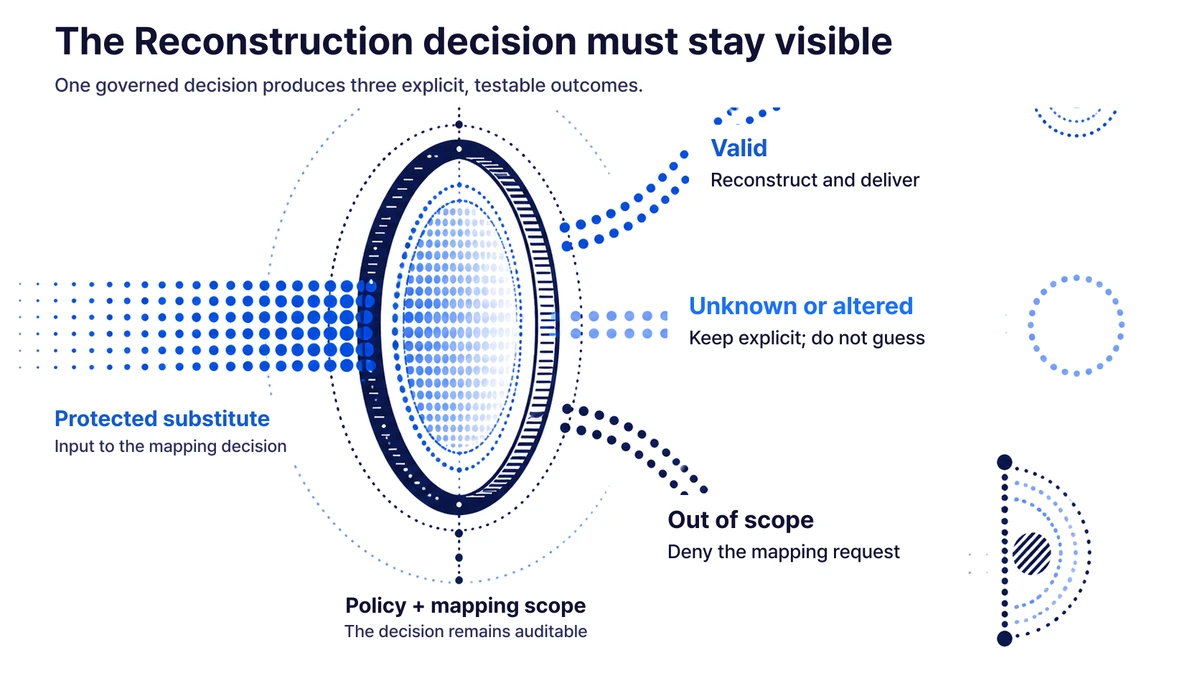
This distinction prevents a misleading pass. A test should not turn an invalid reference into a guessed original merely to produce clean output. It should show which references were valid, which policy authorized them, what remained unresolved, and how the workflow responded.
What evidence should one test run capture?
One test run should capture enough evidence to trace the return path without creating unnecessary copies of the original values. The evidence package needs identifiers, decisions, and outcomes—not a second unprotected dataset inside the observability stack.
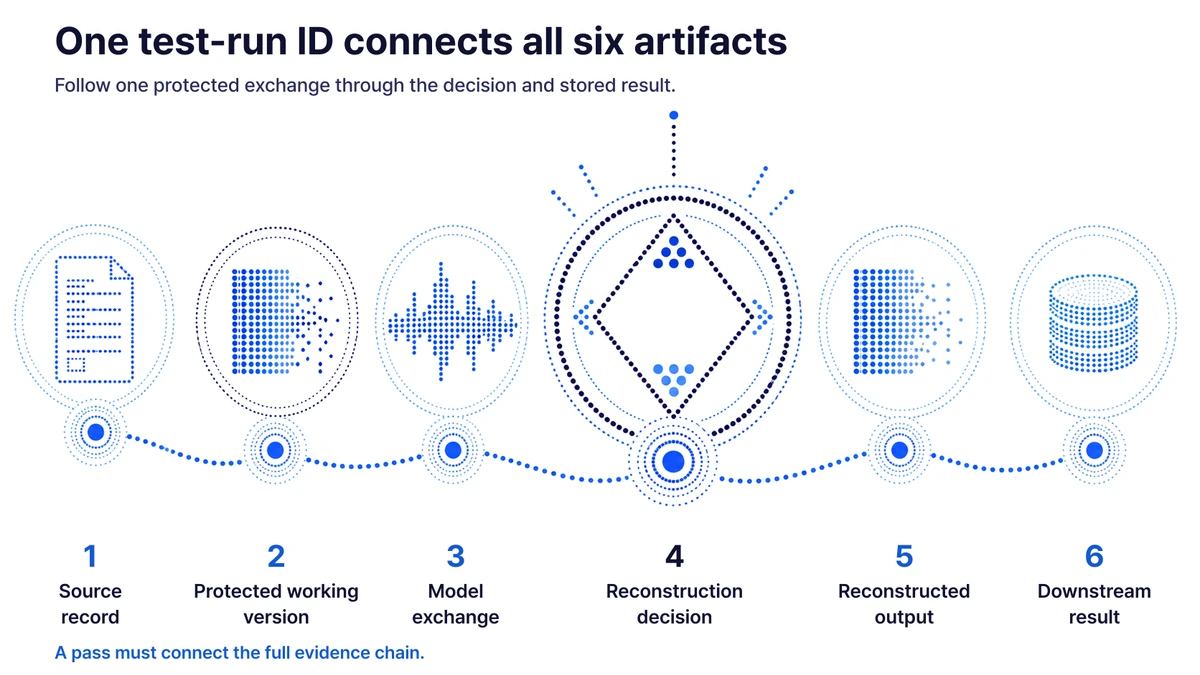
At minimum, connect these six artifacts:
- Source record: the bounded input and the relationships the task must preserve.
- Protected working version: the representation prepared inside the customer-controlled environment.
- Model exchange: the exact protected request and returned response on the approved model path.
- Reconstruction decision: caller identity, policy, mapping scope, valid and invalid references, and decision timestamp.
- Reconstructed output: the authorized values returned to the workflow.
- Downstream result: the object actually stored, displayed, or sent by the originating application.
Give the artifacts a shared test-run ID so reviewers can follow them without joining on sensitive values. Record the workflow owner, model route, mapping scope, policy version, output destination, result, and rollback action. When a log needs to identify a reference, use the approved internal identifier or event ID rather than writing the original value again.
NIST’s Generative AI Profile frames generative AI risk management across design, development, use, and evaluation. It does not prescribe a Reconstruction test, but it supports keeping evaluation evidence tied to the operating system rather than treating model output as the only object under review.
Which happy-path cases establish usable output?
Happy-path tests should establish that valid, authorized references remain connected across the complete workflow. One clean example is not enough; the cases should reflect the relationships and output formats the production task depends on.
Start with a bounded record that contains repeated references and more than one type of operational marker. For example, use one circuit in several sections, two distinct topology nodes, and an incident ID that appears in both prose and a structured field. Define the expected reconstructed result before sending the protected working version to the model.
Test the following conditions:
- Repeated reference: every valid occurrence of the same substitute reconnects to the same authorized value within the locked scope.
- Distinct entities: two different substitutes remain distinct after Reconstruction.
- Selective authorization: fields permitted for the caller reconnect, while fields outside the caller’s policy do not silently appear.
- Structure: references in prose, lists, tables, citations, or structured fields land in the intended location.
- Destination: the downstream system receives the approved reconstructed output, not an intermediate response.
- Audit link: the stored result can be traced to the test run, policy, caller, and mapping scope without exposing unnecessary originals.
The pass condition should describe the business object, not just a replacement count. “All five substitutes resolved” is weaker than “the final incident ticket contains the correct circuit and node references in the approved fields, while the restricted customer field remains unresolved for this caller.”
This is also where teams should verify the input-side contract. If references were already merged, split, or removed before the model ran, Reconstruction cannot repair the relationship. The input-side substitution design choices article provides the adjacent architecture context; its title retains the terminology used by that existing article.
Which failure cases must the return path reject or surface?
The return path must make invalid and unauthorized cases visible. The exact response—reject, leave unresolved, flag, or route for review—depends on the deployment and workflow, but silently guessing an original value is not an acceptable test outcome.
Build negative cases deliberately:
- change one character in a valid substitute;
- remove part of a substitute from a streamed or truncated response;
- duplicate a valid substitute in a field where only one reference is allowed;
- add a substitute-shaped value that never appeared in the protected input;
- submit a reference from another session, tenant, document, or workflow scope;
- use an expired or revoked mapping;
- call Reconstruction with an identity that lacks permission;
- retry after a timeout and attempt the same downstream write twice.
For each case, define the expected state before running the test. Reviewers should be able to distinguish a valid reconstructed value, an intentionally unresolved reference, a denied operation, a retryable error, and a rejected downstream write. A generic error message that hides the category is difficult to operate and audit.
Cross-scope testing is especially important. Deterministic behavior is meaningful only inside the scope used to create and resolve the substitute. A reference from another scope should not resolve merely because its shape looks valid. The test should capture the scope identifier and the explicit decision without exposing the underlying value.
Retries add a different risk. If Reconstruction succeeds but the downstream application times out, a retry may repeat the resolution or duplicate the write. The workflow needs an idempotency or duplicate-handling rule that can be tested at the destination, not inferred from an HTTP success response.
How do teams test the environment boundary and operational residue?
Test the environment boundary by observing where every representation is processed and stored during normal and failed runs. Original values and the protected mapping layer should remain within the customer-controlled environment described by the current LLM Capsule architecture, while only the protected working version follows the approved model path.
Use the LLM Capsule architecture to identify the intended components, then verify the deployed workflow rather than relying on the diagram alone. Capture the network route, service identity, mapping location, temporary storage, response destination, and downstream system for the actual test.
Operational residue belongs inside the same boundary review. Trigger a provider timeout, parser failure, denied Reconstruction request, expired mapping, retry, and downstream rejection. Inspect:
- application and access logs;
- distributed traces and model telemetry;
- caches and temporary files;
- retry queues and dead-letter stores;
- error payloads and support exports;
- backups and recovery copies;
- the final downstream record.
The UK Information Commissioner’s Office guidance on pseudonymisation says that additional information used to reconnect pseudonymous data should be kept separately and protected with access control, logging, key management, backup, and review. That is jurisdiction-specific guidance, not a universal compliance conclusion, but it provides useful control questions when the mapping involves personal data.
Alternative transformation systems also have different state and reversibility requirements. Google Cloud’s pseudonymization documentation distinguishes reversible deterministic encryption, format-preserving encryption, and one-way hashing, and explains how keys, annotations, and context can affect re-identification and referential integrity. Those details describe Google Cloud’s service, not LLM Capsule. They illustrate why a test must verify the actual mapping method and scope instead of relying on a broad label.
What is the go/no-go checklist for production?
Approve the Reconstruction stage only when the team can show exact handling for valid cases, explicit handling for invalid cases, enforced authorization and scope, and a downstream result that matches the approved expectation. An unresolved gap needs an owner and remediation date; it should not disappear behind an overall pass score.
Deterministic Reconstruction acceptance criteria
This table is a test contract, not product proof. Replace generic artifact names with the actual service, policy, event, and destination identifiers used by the deployment.
Run the suite again whenever a material part of the return path changes: model endpoint, substitute format, mapping scope, authorization policy, Reconstruction component, response parser, observability stack, downstream destination, or retention rule. A past pass does not prove the current path.
The final decision is simple: approve the workflow only when a reviewer can trace one real protected request through Reconstruction to the stored result, reproduce both allowed and denied outcomes, and explain every unresolved reference and operational copy. If the evidence stops before the downstream write, the return path has not been fully tested.