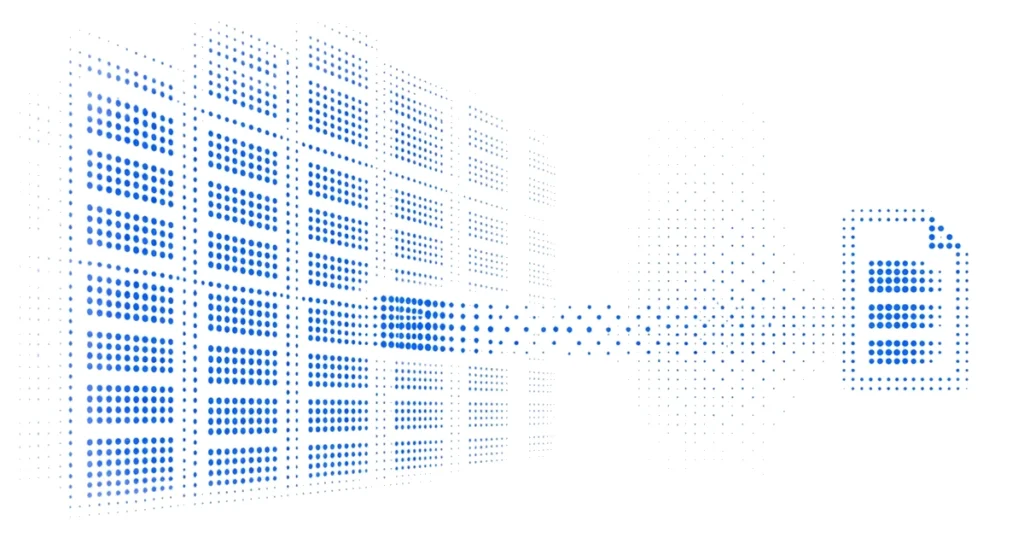
A restricted document can take on many forms inside a retrieval-augmented generation workflow. A single contract clause may become extracted text, a chunk, metadata, an embedding, retrieved context, a citation, or a log entry. RAG on restricted documents therefore requires a boundary that covers the entire retrieval and return path, not just the vector database.
Consider an authorized analyst comparing two restricted contracts. The system must retrieve the correct clauses, keep original names out of an unapproved model route, retain enough citation detail for verification, and deliver the answer only to an authorized destination. Each stage requires its own boundary decision.
Key takeaways
- Treat the RAG pipeline as multiple data-handling stages, each with its own stores and identities.
- Protect restricted values before model-bound context is assembled, while preserving the relationships needed for retrieval and reasoning.
- Keep citation identity stable from the source document through the generated answer.
- Test denied retrieval, unknown references, stale indexes, prompt leakage, and the final restored write.
Where does restricted content appear in a RAG pipeline?
The original RAG architecture combines a model’s parametric memory with retrieved passages from a non-parametric index. In production, the contract clause may pass through extraction and chunking, an index, retrieval and reranking, prompt assembly, model inference, output processing, and the application response.
Restricted information can surface at each stage. A chunk may repeat a contract name, while metadata may reveal its customer or project. Treat embeddings as derived data and decide explicitly how they enter the system’s data inventory. Individually permitted fields may also become sensitive when the prompt combines them. The same review must cover retrieval traces, generated quotations, caches, and logs.
Trace one clause from the source contract to the user-visible result. Record every component that stores, transforms, or observes it. Once that path is visible, the first durable design choice is what the index may retain.
Decide what the index is allowed to contain
For the contract workflow, the index might retain raw clause text inside a controlled environment, protected text, stable references, or a combination. There is no universal rule that every restricted document must remain outside every index. The decision depends on the deployment boundary, access model, retrieval design, and governing requirements.
For each document class, specify:
- where extraction and chunking run;
- whether the index stores raw text, protected text, references, or a combination;
- which metadata fields are searchable;
- how document and chunk identity remain stable across versions;
- who can retrieve each scope;
- how deletion and re-indexing propagate; and
- what evidence proves the configured behavior.
Protection may reduce disclosure, but transformation can also remove distinctions that retrieval depends on. If that happens, relevance can degrade. Evaluate retrieval against the protected representation, corpus, and task that will actually run in production.
Protect the context before the approved model path
Retrieval authorization and model disclosure are separate decisions. The first determines which clauses the caller may retrieve. Microsoft’s secure multitenant RAG guidance describes carrying identity through the request chain and limiting grounding data to content the user is authorized to access. The second decision determines what form of that evidence may cross the approved model path.
LLM Capsule operates as a context-preserving data layer for AI. Original values and the protected mapping remain inside the customer-controlled environment. In the contract scenario, the retriever selects the authorized clauses, while the RAG workflow assembles a protected working version that preserves supported relationships and references before the request follows the approved model path.
This design separates retrieval authority from model disclosure. The retriever can select evidence under the customer’s access controls, while the model receives only the protected context approved for that route. After generation, restore resolves supported references inside the protected workflow and returns the authorized result to its destination.
The placement still varies by deployment. Some systems may protect documents before indexing. Others may index within a controlled environment and protect only the retrieved context before prompt assembly. Record the chosen pattern and test it against the deployed path; the product category does not make that decision automatically.
For the contract workflow, the approval record should answer one question at each stage:
Preserve citations without leaking the source
The reviewer needs enough source identity to verify the answer, but the model route should not receive unnecessary restricted titles, paths, or snippets. Define a citation contract that keeps the source stable while limiting what crosses that route.
One workable pattern is to carry a protected document reference, version, page or section locator, and chunk identity through generation. The application can resolve that reference after authorization, rather than placing the original title or restricted path in the prompt. Test repeated citations, moved sections, deleted documents, and answers that cite a chunk not present in the retrieval set.
The generated prose also needs a boundary. Restore should resolve supported protected references, not guess what an invented string was meant to represent. Unknown or altered references should remain explicit and enter a review or failure path.
Test retrieval and return failures together
Suppose the retriever finds the correct contract clause, but the caller is not authorized to use it. The workflow must fail even if the generated answer would otherwise be accurate. A different run may pass retrieval and generation, then fail when the destination rejects the final write. Production testing must join both halves.
Test the workflow against both valid and failure conditions:
- An authorized query retrieves evidence from multiple relevant restricted documents.
- The caller cannot access one document in the candidate set.
- The index contains a stale or partially deleted entry.
- The response includes an altered or unknown protected reference.
- A prompt or retrieval trace attempts to record original context.
- The answer cites content outside the retrieved set.
- Restore succeeds, but the downstream write times out, is duplicated, or is rejected.
NIST’s Generative AI Profile calls for reassessing model risks after RAG is introduced and for checking grounding sources and citations during testing and monitoring. The test record should therefore connect the retrieval configuration, model route, policy version, protected context, response, restore decision, and final delivery.
Set a narrow production contract
Approval should attach to a specific operating contract: defined document classes, permitted callers and questions, the approved model route, citation behavior, restore scope, and destination. Record what happens when a reference cannot be resolved or the final write fails.
Anything outside that tested envelope returns to review. This gives operators a runnable boundary and reviewers a concrete evidence set instead of treating “restricted-document RAG” as a single approval category.