You can run AI on circuit IDs without sending the raw values through the approved model path. Define each circuit ID as an operational marker, create a protected working version inside your environment, and restore original values only after the response returns to an authorized integration. The deployment review must still confirm that raw values do not leak through logs, retries, observability, or an unapproved output destination.
This article follows one illustrative incident fragment. It uses the public demo value CKT-77-AB12, not customer data. The narrow goal is to test the complete return path for one identifier. For the wider NOC use case, including topology and incident RCA, see the broader network-operations workflow.
Key takeaways
- The target architecture keeps the raw circuit ID and internal mapping inside the customer environment.
- The approved model receives a protected stand-in that preserves the record's relationships.
- Model output remains protected until the integration applies the workflow's approved return checks.
- Restore produces the authorized, usable result inside the originating environment.
What are we tracing?
The trace starts with one incident record that contains a circuit reference, a node reference, and an observed condition. RFC 3046 defines the DHCP relay-agent Circuit ID as an agent-local identifier of the circuit from which a client-to-server packet arrived. The same specification treats its value as opaque, and implementations may encode interface, port, or virtual-circuit information.
That definition does not make every circuit ID harmless. RFC 7819 notes that relay-agent information can reveal network or subscriber context and, in some deployments, support location inference. Sensitivity therefore depends on the encoding, its linkability, and the surrounding data. The operator's schema and workflow policy, not a universal label, must decide how to handle it.
The illustrative source record is:
incident=INC-2026-0142
circuit_id=CKT-77-AB12
node=edge-04
condition=flapping
question=Why is this happening, and what should the operator check?
The model needs the relationship between the circuit, node, condition, and question. It does not need the literal strings CKT-77-AB12 or edge-04. Those two values can remain inside while the protected working version carries stable references to them.
Step 1: Define the circuit ID as an operational marker
Start the policy before the model call. The customer marks circuit_id and node as operational markers for this workflow, while ordinary fields such as condition and question remain readable. The policy should also record the workflow type, allowed model path, permitted output destination, and policy version.
The decision belongs to the team that owns the data and workflow. A generic PII list cannot decide whether CKT-77-AB12 reveals sensitive network information in this environment. Treat it as an operational identifier whose sensitivity depends on encoding, linkability, and deployment context. The current LLM Capsule architecture lets teams define business-specific markers such as circuit IDs and topology nodes, then applies the selected policy before the model request leaves the customer boundary.
Keep the first proof small. One representative incident makes it easier to inspect the exact input, policy match, generated stand-ins, model output, and restore destination without hiding a failure inside a large batch.
Step 2: Create a protected working version
In the documented architecture, LLM Capsule substitutes the selected values inside the customer environment and keeps their internal mapping there. The protected record retains the field relationships needed for this task, so the model can refer to a circuit on a node without receiving either original identifier. This follows the data-minimization principle in RFC 6973: disclose only the data needed for the task. The RFC supports the design principle, not the product implementation.
incident=INC-2026-0142
circuit_id=<capsule:circuit_1>
node=<capsule:node_1>
condition=flapping
question=Why is this happening, and what should the operator check?
The mapping remains local:
<capsule:circuit_1> -> CKT-77-AB12
<capsule:node_1>    -> edge-04
workflow            -> INC-2026-0142
policy_version      -> noc-circuit-v2
The stand-ins are stable within this illustrative request, preserving the relationship between the circuit and node. They are not anonymous values or permission to reveal the originals. The mapping, caller identity, and output policy still control whether the response can become restored output.
Step 3: Send only the protected record through the approved model path
The approved model receives the protected working version, not the mapping. LLM Capsule's documented architecture places the context-preserving data layer between operational data and an external, VPC-hosted, or on-prem model path. Only the protected version should travel that route, while original values remain inside the customer environment.
The route itself still needs governance. The NIST Generative AI Profile recommends evaluating privacy, security, and supply-chain risks when organizations use third-party generative AI systems. That guidance supports reviewing the model provider and integration boundary; it does not prove a particular LLM Capsule deployment is configured correctly.
An approved model might return:
The flapping condition on <capsule:node_1> may indicate interface or optic instability.
Check error counters and optical levels, then monitor <capsule:circuit_1> after the approved remediation.
The output is useful because it preserves the two stand-ins and their relationship. It is not ready for an operator yet. The raw circuit and node values should not reappear until the response reaches the customer-controlled restore boundary and passes the workflow's authorization checks.
Step 4: Check authorization before restore
Restore should start only after the integration verifies that this response belongs to the original workflow and may be written to the requested destination. The production Reconstruction guide describes restore as an in-environment operation that reads the internal mapping and places access control and audit at the return boundary.
The following list is an architecture-review checklist for this example, not a claim that every deployment enforces these fields automatically:
- The caller or service identity is allowed to restore for
INC-2026-0142. - The response came through the approved model path attached to this workflow.
- Each stand-in belongs to the mapping for this request and policy version.
- The destination ticket or console may receive the original circuit and node values.
- The response contains no unknown or malformed stand-in that lacks a mapping entry.
- The audit event records the workflow, policy, destination, time, and result without copying raw values into an unauthorized log.

When the implementation enforces these checks, the integration separates model completion from permission to reveal the original values. A successful model response does not authorize restore by itself.
Step 5: Restore the answer inside the customer environment
In the documented return path, LLM Capsule reads the internal mapping and replaces recognized stand-ins inside the customer environment after the configured checks pass. Restore does not require sending the mapping back to the model. The resulting text can return to the authorized NOC ticket, console, or workflow as restored output.
The flapping condition on edge-04 may indicate interface or optic instability.
Check error counters and optical levels, then monitor CKT-77-AB12 after the approved remediation.
The team can now inspect the complete round trip. The model reasoned over the protected relationship, and the operator received the circuit and node references required for the next action. Before approval, verify the same boundary across request handling, retries, logs, tracing, and the final destination. The public architecture describes the intended path; deployment evidence must show that the implementation follows it.
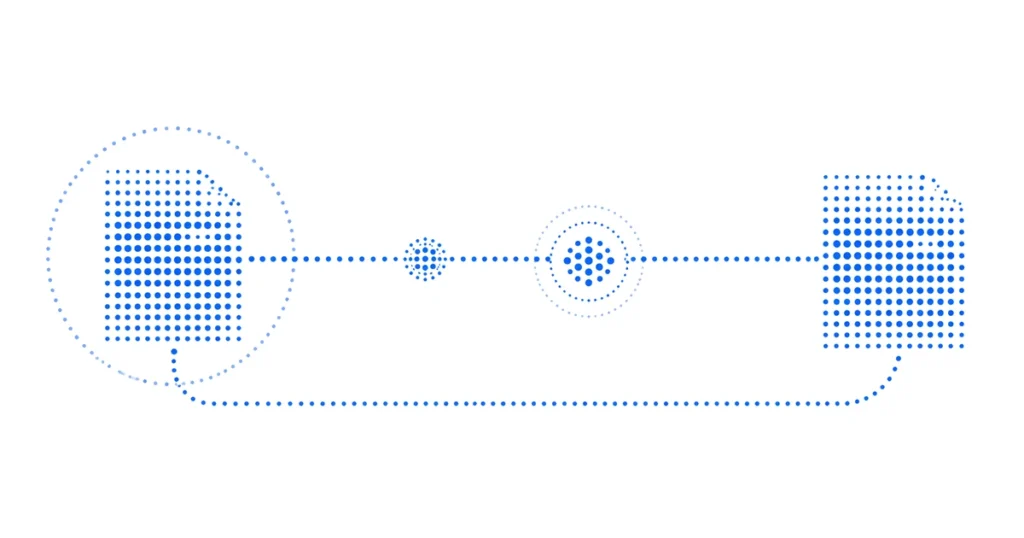
One circuit ID across the complete AI round trip
What can invalidate the round trip?
Two failures deserve explicit tests. First, the model can produce a stand-in-shaped string that does not exist in the mapping. The Reconstruction guide describes workflow choices such as flagging the reference, removing it with transparent handling, or rejecting and re-prompting the response. The configured behavior must be verified for the deployment, and the integration must not invent an original value for an unknown stand-in.
Second, a valid mapping does not make every destination valid. A response restored into an unrestricted log, chat room, or analytics store would expose the raw values outside the intended workflow. Test the output destination and its access rules before the first production request, then include that destination in the restore audit event.
Approval checklist for one circuit-ID workflow
An architecture team can approve the trace only when it can answer each item with current evidence:
- Which fields count as operational markers for this workflow?
- Where do the raw circuit ID and internal mapping remain?
- Which approved model path receives the protected working version?
- How does the integration bind the model response to the original workflow and policy version?
- Which service identity can request restore?
- Which ticket, console, or system may receive the restored output?
- How does the workflow handle unknown or malformed stand-ins?
- What audit metadata is recorded, and where is that audit stored?
Run the proof with one representative payload and capture the input, protected version, model output, return-check result, restored output, and audit record. Also inspect retry, error, logging, and observability paths. A team that cannot inspect these artifacts has not yet verified the complete data path.